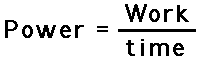
Power is the rate at which work is done. It is the work/time ratio. Mathematically, it is computed using the following equation.
- The quantity work has to do with a force causing a displacement.
- Work is no related to the amount of time that this force acts to cause the displacement.
Sometimes, the work is done very quickly and other times the work is done rather slowly. For example, a rock climber takes an abnormally long time to elevate her body up a few meters along the side of a cliff.
A trail hiker (who selects the easier path up the mountain) might elevate her body a few meters in a short amount of time. The two people might do the same amount of work, yet the hiker does the work in considerably less time than the rock climber. The quantity that has to do with the rate at which a certain amount of work is done is known as the power. The hiker has a greater power rating than the rock climber.
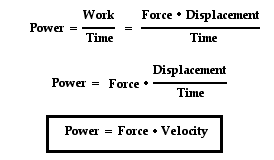
The expression for power is work/time. And since the expression for work is force*displacement, the expression for power can be rewritten as (force*displacement)/time. Since the expression for velocity is displacement/time, the expression for power can be rewritten once more as force*velocity. This is shown below.
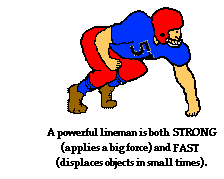
This new equation for power reveals that a powerful machine is both strong (big force) and fast (big velocity).
- A powerful car engine is strong and fast.
- A powerful piece of farm equipment is strong and fast.
- A powerful weightlifter is strong and fast.
- A powerful lineman on a football team is strong and fast.
- A machine that is strong enough to apply a big force to cause a displacement in a small mount of time (i.e., a big velocity) is a powerful machine.
For more information on newton's first law of motion, please visit this website :-